
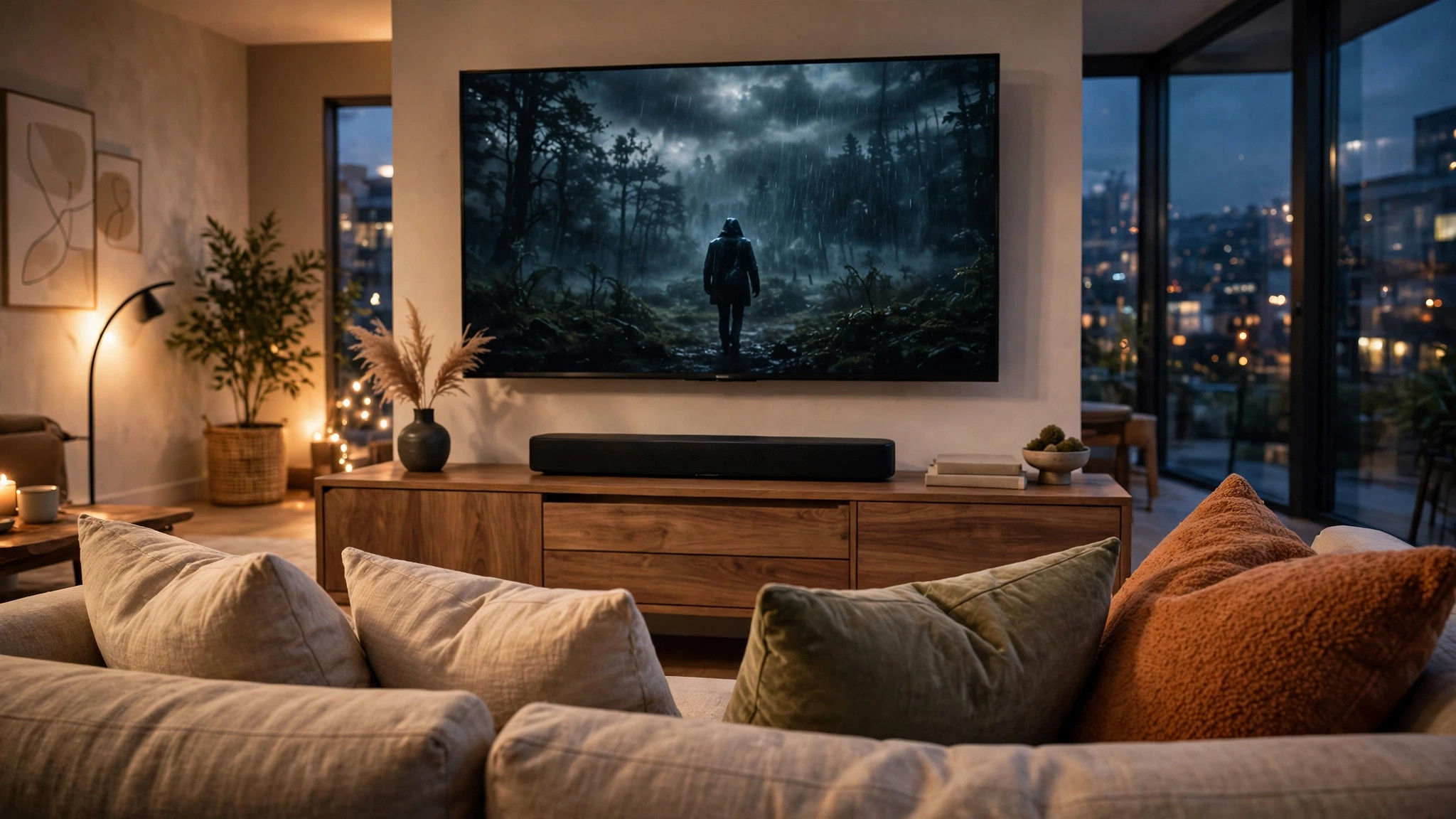

TV speakers are the weakest part of every modern TV. The panel is a few millimeters thick, the speakers point down or backward, and the design assumes you will fix the sound yourself. The choice is a soundbar or real speakers. Both can sound excellent. They go wrong in different ways, and the right choice has more to do with your room than with your budget.
What a soundbar does well
A soundbar’s first job is dialogue, and it is genuinely good at it. TV speakers mumble because the center channel, where almost all speech lives, gets squeezed through tiny drivers firing at your floor. A soundbar puts a dedicated center channel under the screen, firing at you, and whispered lines stop being a guessing game.
The second thing a soundbar does well is disappear. One long box under the TV, one HDMI cable into the ARC or eARC port, and it turns on and off with the TV remote. Add a wireless subwoofer and you get real bass for movies without running a single wire across the room. Setup takes an evening, not a weekend. Sonos built its reputation on this with the Beam and the Arc, and Samsung, Sony, and Bose all sell the same idea in different boxes.
Modern soundbars also fake surround sound surprisingly well. They use angled drivers and signal processing to bounce sound off your side walls so effects seem to come from beside you or even slightly behind you. Upfiring drivers bounce sound off the ceiling for Dolby Atmos height effects. In a normal rectangular room with walls in the right places, the trick is convincing: rain sounds like it is falling around you, and a car chase moves across the room instead of sitting inside a flat box.
Our take: for most people, in most rooms, a good soundbar is not a compromise. Dialogue gets clear, movies get weight, and you never think about it again.
What a soundbar physically cannot do
Here is the catch, and it is physics, not effort. Every driver in a soundbar sits in front of you, so surround sound is a simulation: sound fired sideways, bounced off a wall, and timed to arrive as if it came from behind. When the room cooperates, your brain buys it. When it does not, it does not.
The room cooperates when it has side walls at roughly the right distance and a flat ceiling at a normal height. Open-plan living rooms are the problem case. If one side of your seating area opens into a kitchen and the other side is a wall of windows, there is nothing for the sound to bounce off on one side, and the soundstage collapses toward the wall that exists. Vaulted or beamed ceilings scatter the height effects, so Atmos sounds vague instead of overhead. None of this is fixable with settings. You cannot bounce sound off a wall that is not there.
Small drivers are the other limit. A wireless subwoofer handles the low end, but the scale of the sound stays front-of-room: a full orchestra sounds big, but big from one direction.
Our take: judge a soundbar by your room, not its spec sheet. In an open or high-ceilinged room, no amount of processing papers over the missing walls.
What real speakers do differently
A surround system does not simulate anything. A speaker behind your left shoulder plays the sound meant to be behind your left shoulder. A helicopter flies overhead because there are speakers in the ceiling or firing upward from the front pair. Nothing is bounced, timed, or hoped for.
Real speakers also move more air. A bookshelf speaker from Klipsch, Polk, or ELAC, or a compact SVS package, has drivers several times the size of a soundbar’s, powered by a receiver from Denon or Yamaha. The result is not just louder but more dynamic: quiet passages stay quiet, explosions hit harder, and music sounds like music instead of a soundtrack.
The price is everything around the speakers: a receiver, speaker wire or wireless surrounds, stands or mounts, and an afternoon with a calibration microphone while the receiver learns your room. Denon’s Audyssey and Yamaha’s YPAO do a solid job, but it is still a project, and the speakers are visible in a way a soundbar is not.
Our take: nothing simulated matches the real thing. If movies are the main event and your room can take speakers, separates are still the best sound you can buy.
Your room decides more than your budget does
A closed, roughly rectangular room with a couch in the middle suits both options. Almost anything works there, so buy on simplicity and budget.
Tricky rooms decide for you. If your couch sits against the back wall, true rear speakers have nowhere to go; mounting them on the side walls works, but you lose some of the behind-you effect. If your ceiling is vaulted or beamed, Atmos height effects get mushy from any upfiring source, and in-ceiling speakers become the only honest way to get overhead sound. If your living room opens into the kitchen on one side, a soundbar loses its reflections and separates lose nothing, because their speakers are where the sound is supposed to come from.
Measure the room before you shop: walls, ceiling height, and couch position tell you more than any review.
Setup effort and wires, honestly
A soundbar takes an evening: unbox, one HDMI cable, quick setup, done. A surround system takes a weekend: place five or seven speakers, run wire or set up wireless rears, connect the receiver, run calibration, then move the speakers twice because the first placement sounded wrong. Wireless surrounds from Sonos and Samsung cut the wire problem down, but they need power outlets and cost more than wired equivalents.
Then there is the household factor. A soundbar is one remote and nothing to learn. A receiver means inputs, listening modes, and a second remote, and everyone in the house has to learn which button makes the TV work. Know which house you live in.
Who should buy which
Buy a soundbar if you want better sound with zero fuss, if your room is small or open-plan, or if the idea of running speaker wire makes you tired just reading it. A mid-range soundbar with a wireless subwoofer is the right answer for most living rooms, and a flagship like Samsung’s HW-Q990D, which adds wireless rears and a sub, gets surprisingly close to a real system.
Buy separate speakers if you have a room that can take them, if movies are a weekly event rather than background noise, and if you enjoy the setup process. Start with a 5.1 package and a decent receiver, and add height speakers later.
And if you go the soundbar route, spend twenty minutes setting up the TV itself properly once it arrives. The sound settings, including turning off the internal speakers and enabling eARC, matter as much as the soundbar. Our guide to setting up a new smart TV walks through exactly that.
The bottom line
A soundbar wins on simplicity, and outright in rooms where reflections work. Real speakers win on immersion, always, and by more the bigger and more closed your room is. The bad purchase is the impressive system that never gets set up right, or the clever soundbar bouncing sound off walls that do not exist. Match the gear to the room you actually have.